
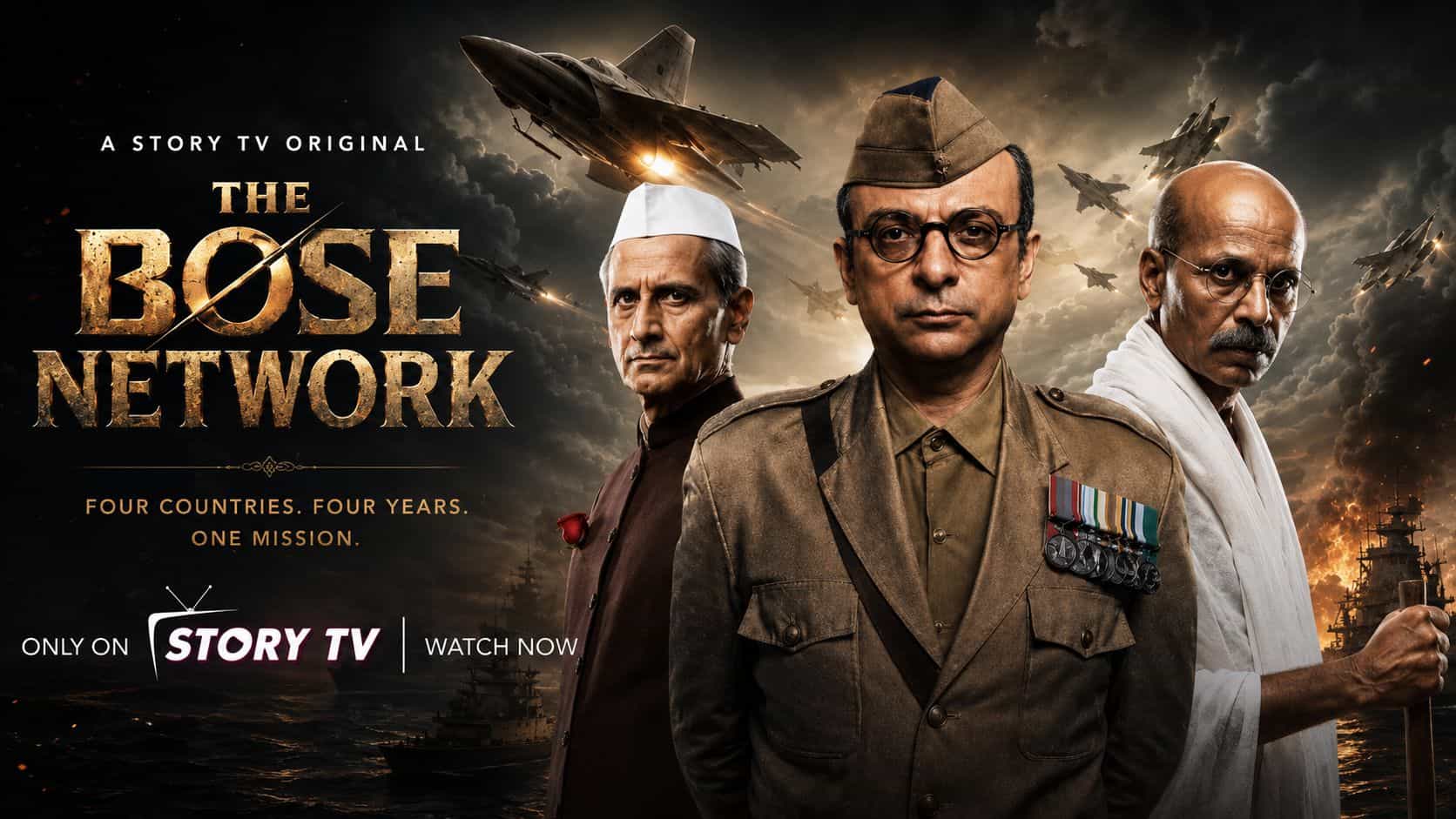
Story TV is set to premiere The Bose Network at midnight on 15 August, bringing the story of Netaji Subhash Chandra Bose and the 1940s to the vertical-screen format. Described as India’s first title built using an AI-integrated production pipeline, the historical thriller stars Joy Sengupta as Netaji Subhash Chandra Bose.
Written and directed by Lalit Marathe, one of the writers of Swades, The Bose Network uses a combination of live-action filmmaking and AI-assisted post-production to recreate historical environments across Calcutta, Kabul and wartime Berlin, along with the interiors of two submarines.
All episodes of The Bose Network will be available on the Story TV app from midnight on 15 August in Hindi, Tamil and Telugu.

The Bose Network Release Date, Cast and Streaming Details
| Details | Information |
|---|---|
| Series | The Bose Network |
| Release Date | 15 August |
| Release Time | Midnight |
| Streaming Platform | Story TV |
| Languages | Hindi, Tamil, Telugu |
| Genre | Historical Thriller |
| Format | Vertical Microdrama |
| Lead Actor | Joy Sengupta |
| Character | Netaji Subhash Chandra Bose |
| Writer & Director | Lalit Marathe |
| Research | Based on research by Chandrachur Ghose |
| Cinematographer | Sudip Sengupta |
| Executive Producer | Jar Pictures |
| Production Approach | Live Action with AI-Integrated Production Pipeline |
Joy Sengupta as Netaji Subhash Chandra Bose
Joy Sengupta plays Netaji Subhash Chandra Bose in The Bose Network, which explores events and movements associated with Bose during the 1940s.
Rather than approaching the project purely as a conventional historical drama, Story TV has designed the series for its vertical storytelling format while using AI extensively during post-production to create the period world required by the narrative.
The series takes audiences through four countries and four years of wartime history, recreating different locations and environments connected to the story.
The Bose Network Uses AI to Recreate the 1940s
One of the central production features of The Bose Network is its use of an AI-integrated production pipeline.
The series recreates 1940s Calcutta, the Frontier Kabul and wartime Berlin, along with the interiors of two submarines.
Eloelo Group’s AI technology was extensively used during post-production to build these period environments. This allowed the story to move between different countries, historical periods and settings while retaining the vertical format used by Story TV.
The production combines traditional elements such as writing, actors, performances, cinematography and sound with AI-assisted environment creation.
A Hybrid Approach Rather Than a Fully AI-Generated Series
The Bose Network uses AI as part of its production process rather than presenting the entire series as purely AI-generated.
Actors and conventional filmmaking remain central to the project, while Artificial Intelligence is primarily used to expand and recreate environments during post-production.
Story TV sees this hybrid approach as a way to produce visually ambitious period stories for the vertical format while allowing greater production focus to remain on writing, casting, performances and sound.
The technology developed for such productions can also be reused for future stories requiring different locations, historical periods and visual settings.
Based on Research by Chandrachur Ghose
The Bose Network draws on research by author and Bose scholar Chandrachur Ghose.
Archival materials and documented accounts have been used as references to reconstruct Bose’s movements, the decisions surrounding them and the people involved.
The historical research provides the foundation for the series, while its visual presentation combines filmmaking with AI-assisted recreation of the period.
Lalit Marathe Writes and Directs The Bose Network
Lalit Marathe, who was among the writers of the 2004 film Swades, has written and directed The Bose Network.
According to Lalit Marathe, recreating a historical period requires both research and imagination, particularly when depicting details and environments that no longer exist in their original form.
The AI-driven production approach allowed the creative team to reconstruct the 1940s across several countries on a scale that would otherwise have been difficult for a vertical series.
Sudip Sengupta Handles Cinematography
Sudip Sengupta serves as cinematographer for The Bose Network. His previous credits include projects such as Life of Pi, Neerja, Ramprasad Ki Tehrvi and Arjun Patiala.
Mumbai-based Jar Pictures serves as executive producer of the series. The production banner has previously been associated with films including Killa and Liar’s Dice.
Story TV Expands AI-Powered Production
Artificial Intelligence is becoming an important part of Story TV’s production strategy. According to the platform, AI currently contributes to around 50% of its production workflow.
Story TV is targeting more than 1,000 AI-powered shows by the end of the current fiscal year.
The platform’s strategy is focused not only on using AI to increase the volume of content but also on creating more ambitious visual settings and exploring different genres through premium vertical storytelling.
The Bose Network serves as an example of this approach, using AI to recreate locations and historical environments that would be challenging to produce at a comparable scale through a conventional microdrama production.
Watch The Bose Network From 15 August
The Bose Network arrives as an Independence Day release, with all episodes becoming available from midnight on 15 August.
Viewers can watch the historical thriller through the Story TV app in Hindi, Tamil and Telugu.
With Joy Sengupta portraying Netaji Subhash Chandra Bose, Lalit Marathe handling writing and direction, and AI technology helping recreate the 1940s across different countries, The Bose Network represents Story TV’s attempt to expand the scale of India’s vertical microdrama format.
Stay tuned to Indian TV Info for more updates about The Bose Network, Story TV releases, Indian streaming series, microdramas and upcoming OTT content.