
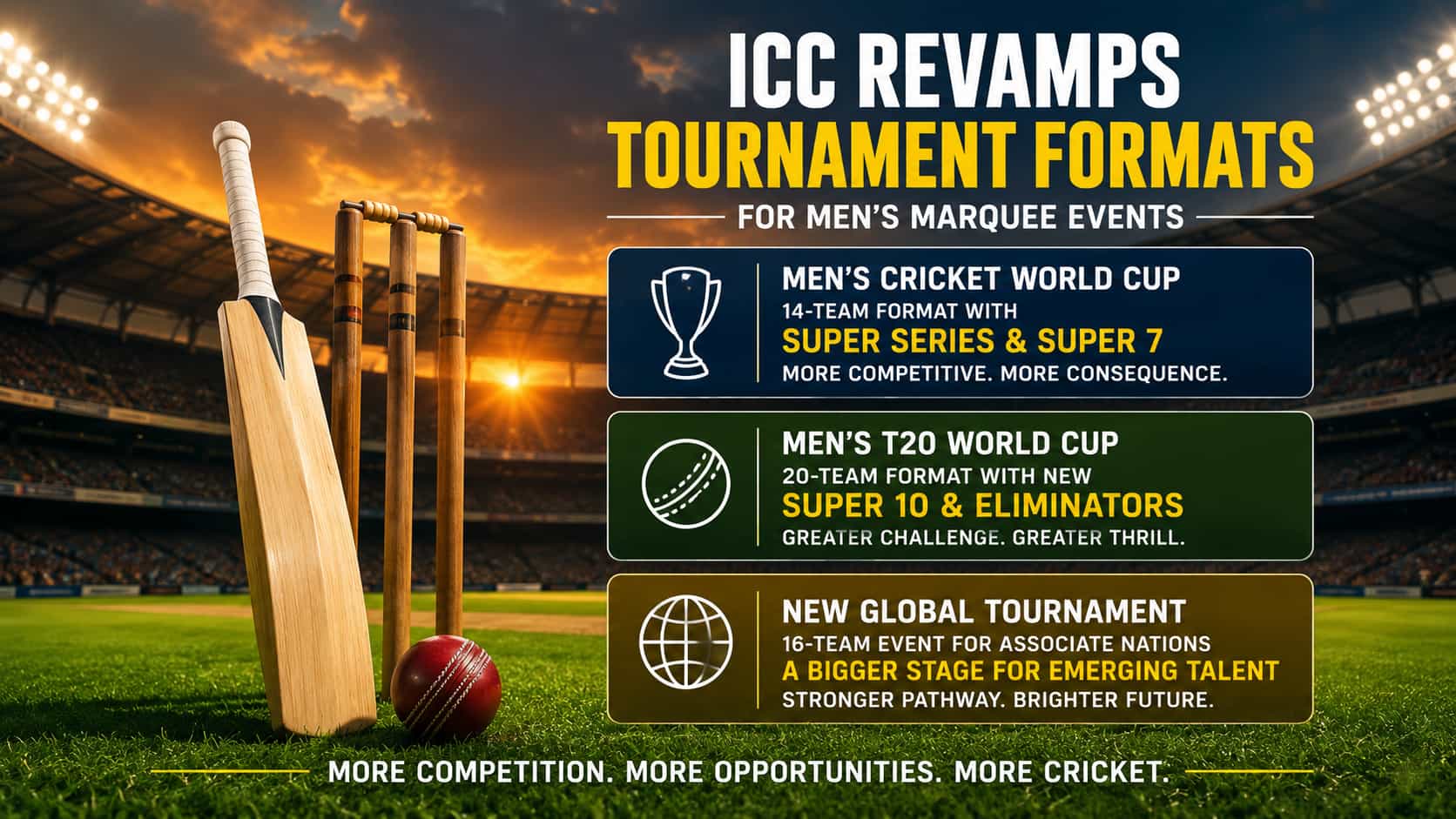
The International Cricket Council (ICC) has announced significant changes to the formats of its premier men’s global tournaments following its annual Board meetings in Edinburgh. The revised competition structures are designed to create more meaningful matches, increase competitiveness from the opening stages, and improve the overall experience for players and fans.
The ICC Board approved changes to the ICC Men’s Cricket World Cup, ICC Men’s T20 World Cup, and the qualification pathway for the ICC Men’s T20 World Cup 2028. In addition, the Board endorsed a proposal for a new global tournament aimed at strengthening competition among Associate Member nations.
Highlights
- 🏏 New format approved for the 14-team ICC Men’s Cricket World Cup.
- 🌍 ICC Men’s T20 World Cup introduces a new Super 10 stage and Eliminators.
- 📈 More opportunities for emerging nations to progress in global tournaments.
- 🏆 New global competition proposed for Associate Member nations.
- ✅ Qualification pathway for the ICC Men’s T20 World Cup 2028 finalized.
ICC Men’s Cricket World Cup Gets New Three-Stage Format
The ICC Men’s Cricket World Cup will continue to feature 14 participating teams, but the tournament structure has been redesigned to increase the importance of every match.

Instead of beginning directly with two large groups, the competition will now include an opening Super Series before the main group stage.
New ICC Men’s Cricket World Cup Format
| Stage | Format |
|---|---|
| Round 1 | Teams ranked 12th, 13th and 14th compete in a Super Series |
| Round 2 | Winner joins two groups of six teams |
| Round 3 | Top seven teams advance to the Super 7 round-robin stage |
| Semi-finals | Top four teams qualify |
| Final | Winners of the semi-finals |
What Changes?
- Every match carries greater importance.
- Lower-ranked teams must earn their place in the main competition.
- The Super 7 stage replaces the previous Super Six format.
- Stronger competitive narrative throughout the tournament.
ICC Men’s T20 World Cup Format Updated
Following the success of emerging teams during the ICC Men’s T20 World Cup 2026, the ICC has also revised the tournament structure.
The competition will continue to feature 20 teams, but the second stage expands from 8 teams to 10 teams.
New T20 World Cup Format
| Stage | Format |
|---|---|
| Group Stage | Five groups of four teams |
| Super 10 | Top two teams from each group qualify |
| Eliminators | Second-placed teams face third-placed teams from the opposite group |
| Semi-finals | Two group winners plus two Eliminator winners |
| Final | Championship Match |
Key Changes
- Five groups instead of four.
- Ten teams reach the Super 10 stage.
- Introduction of Eliminator matches.
- More competitive final stages.
- Greater opportunities for Associate nations.
New Qualification Path for ICC Men’s T20 World Cup 2028
The ICC Board also approved the qualification structure for the 2028 ICC Men’s T20 World Cup.
Qualification Highlights
- Scotland advances directly to the Europe Regional Final.
- Teams that participated in the 2026 T20 World Cup but did not qualify automatically enter the Global Qualifier.
- Regional qualification places include:
- Africa – 2 teams
- Asia – 2 teams
- Europe – 2 teams
- Americas – 1 team
- East Asia-Pacific – 1 team
The highest-ranked team from each region, along with the next three best-performing teams overall, will qualify for the 2028 tournament, subject to minimum performance criteria.
New Tournament Planned for Associate Nations
The ICC Board has also endorsed the creation of a new 16-team global tournament designed specifically for Associate Member nations.
The proposed event would serve as a major international competition and a pathway towards qualification for the ICC Men’s T20 World Cup.
Final approval is expected after review by the ICC Finance & Commercial Affairs Committee during the Board’s November meetings.
Why These Changes Matter
According to the ICC, the revised formats are intended to:
- Increase the significance of every match.
- Improve tournament competitiveness from start to finish.
- Offer more opportunities for emerging cricket nations.
- Deliver a better viewing experience for fans.
- Strengthen the long-term global growth of the sport.
The new competition structures are expected to shape the future of ICC global events while maintaining a balance between established cricketing nations and the sport’s rapidly growing emerging teams.